
Trich Awareness: Skylar’s Story
Oct 1st 2026
October is Trichotillomania Awareness Week, now known as BFRB Awareness Week, a time to bring greater understanding to body-focused repetitive behaviors and the people who live with them.
Trichotillomania, or trich, is a body-focused repetitive behavior involving recurrent hair pulling. Despite affecting millions of people, it remains widely misunderstood and is often difficult to talk about openly.
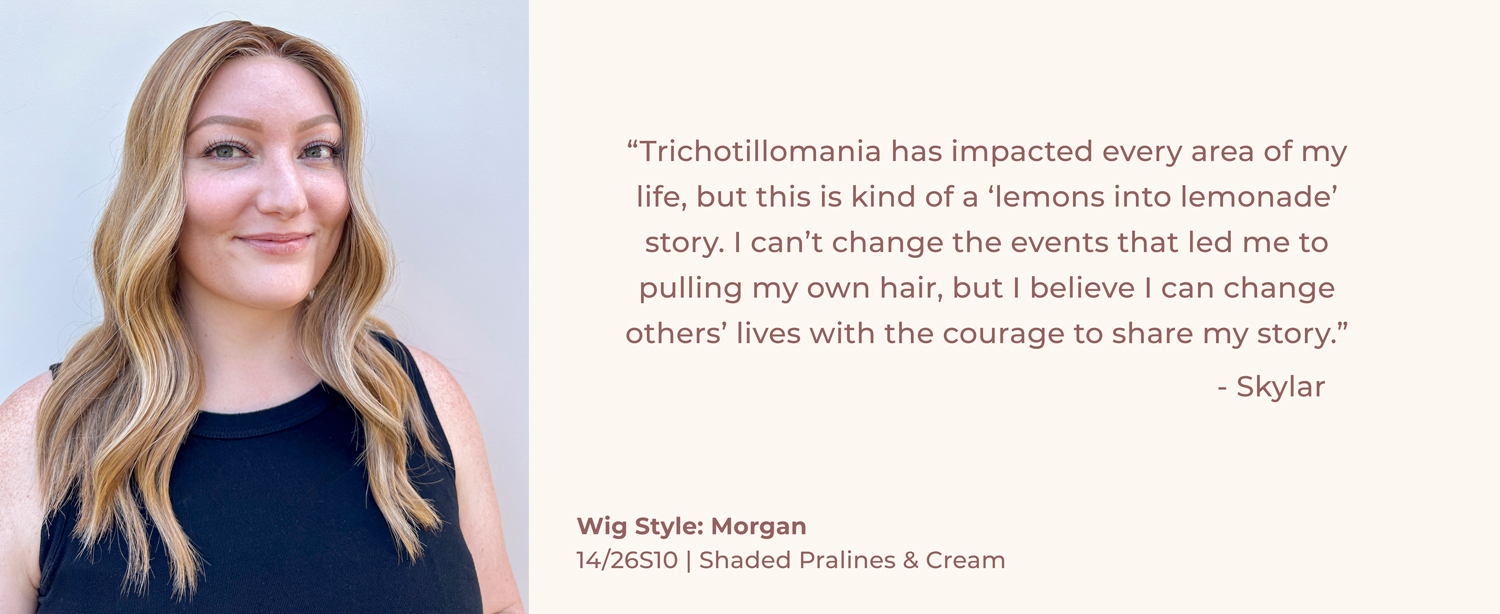
This year, we’re spotlighting our very own Skylar, Custom Product Specialist on the Jon Renau team, who has lived with trichotillomania since she was seven years old. Nearly two decades later, she has learned to navigate hair loss, wigs, self-expression, and the many ways trich has shaped her life.
Skylar was brave enough to share her story with us in her own words, and we’re so grateful for her openness and vulnerability in an effort to help others.
Read her in-depth interview below:
.

Tell us about yourself and your experience with trichotillomania.
I’m 27, I grew up in Southern California, I’m a Licensed Esthetician with a passion for skincare and science – and I’ve had Trich since I was 7 years old!
I started pulling a few hairs when I was seven. By age nine I had gone from long locks to a pixie cut. At age 16, my mom purchased my first wig for me! (From Jon Renau, of course). I vividly remember one of the first times I started pulling, sitting in the back seat of my parent’s car. However, it wasn’t until I had a bald spot at the top of my head that my parents intervened and found a psychologist.
My journey has lasted nearly 20 years, it’s still very much ongoing, and I would be lying if I said it hasn’t changed the course of my life completely. I have had hair loss longer than I’ve had a full head of hair, and in a way, it’s all I know.
Trichotillomania has impacted every area of my life, but this is kind of a” lemons into lemonade” story. I can’t change the events that led me to pulling my own hair, but I believe I can change others’ lives with the courage to share my story.

What do you wish more people understood about trichotillomania?
I think trichotillomania is kind of framed as a self-inflicted disorder, posing the question “Am I the victim or the villain in my own story?”. I wish people knew that trichotillomania isn’t the cause, but rather that trichotillomania has a root cause (pun intended).
For myself and many others, trichotillomania is a response to childhood sexual abuse, PTSD, C-PTSD, trauma, abuse, controlling behaviors and unsafe people/environments. Trichotillomania is a way to self-soothe and regain control at the cost of one’s own appearance, confidence, and livelihood. So often I get the question “Wait, you pull your own hair?” when the question lingering just beneath the surface is “What happened to you that made your mind & body react this way?”.

How has trichotillomania impacted your day-to-day life?
I tell people that trichotillomania isn’t just a disorder, it’s a lifestyle. Every single decision I’ve made from age seven and up has been from a place of self-preservation… and wig preservation. As my hair loss progressed, I gave up my love for swimming. I never learned to braid or curl hair, I didn’t have eyebrows, dating comes at the cost of radical acceptance, friendship comes at the cost of deep fear and the need to hide.
From the minute my feet hit the ground in the morning, my first thought is, “where is my wig or shower cap, I don’t want my roommates to see me without hair”. There is not an area of my life that trichotillomania hasn’t touched. It is always more than hair.

How has trichotillomania influenced your relationship with your hair and your appearance?
At first, hair was a means to an end. I got crafty, my goal was to hide my hair loss any way possible. With tinted dry shampoos, root sprays, beanies, you name it.
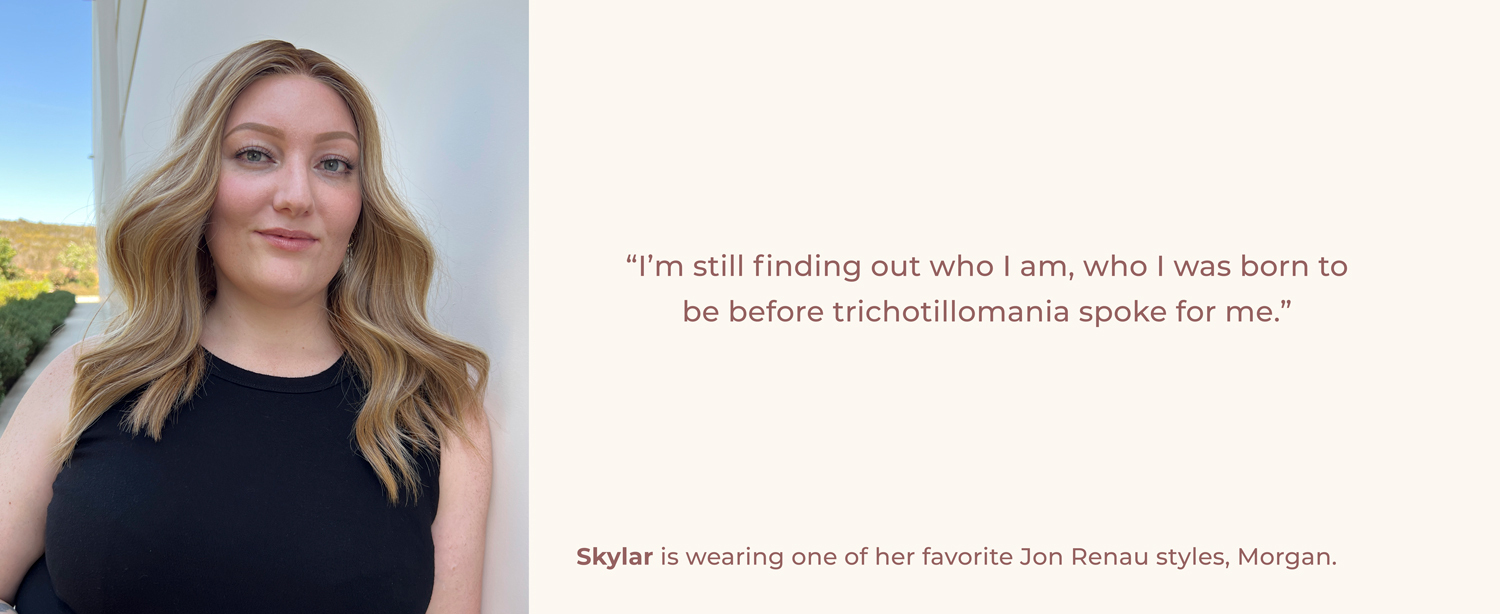
Then when my mom pulled me to the side and told me it was time for a wig at 16 years old, everything changed. Confidence was not a word in my vocabulary. Hair no longer felt like an extension of me (pun intended, of course), it felt like a band aid. It wasn’t until I was 26 years old that I looked in the mirror, decided that if this is my life… then this is my life.
From there on, I’ve embraced [wigs]. I speak on it. Loss is no longer a reason to be afraid, but a reason to connect. I’m finding new, fun ways to express myself through wigs, through accessories. I feel most myself when I’ve drawn my eyebrows on. I’m still learning to love every version of me, but growth is a journey. I’m finally just in a place where I realize that our appearance is a billboard for our personalities and lives – and I want to express myself accordingly.

What role has alternative hair played in your journey?
I got my first wig at 16. Wearing alternative hair in high school came at a cost, especially because I was practically bald one day and had a head full of hair the next. At first, I only wanted to blend in. To restore what was lost in terms of color and length. I would only wear lace front wigs in a specific shade of red to match my bio hair. But as I grew personally, and I became more accepting of this, I realized – I had years to make up for. So, every day now, I wear a different wig. Blonde, brunette, strawberry blonde, raven [black], you name it.
I believe if you get to a point where you’re comfortable enough, wigs can boost your confidence rather than feeling like something you have to hide under. But looking at the nearly 11 years of wearing wigs, I can say that alternative hair restores dignity.

Has wearing alternative hair changed the way you express yourself or feel about your appearance?
Yes! At first, I was so afraid of change, I would only wear a Courtney or Amanda in 27MB. One specific style, one color only, hoping someone couldn’t tell I was wearing a wig. But now… it’s an outlet for my self-expression.
I’m bubbly, I’m artsy, passionate, sassy, creative, finding out who I am after years of OCD telling me who I should be. As my need to hide falls away, the real me comes out. I gladly tell people I have hair loss. I connect with people over it! On Facebook, at the beauty supply store, at the grocery store. A compliment on “my” hair turns into a way to remove the veil of shame. If you own it… then own it!

Looking back, what do you wish you could tell your younger self when you were first experiencing trichotillomania?
You have nothing to be ashamed of. At first this was happening to you – by you- but now, it’s happening for you.

What advice would you give to someone who is currently struggling with trichotillomania or who may be experiencing it for the first time?
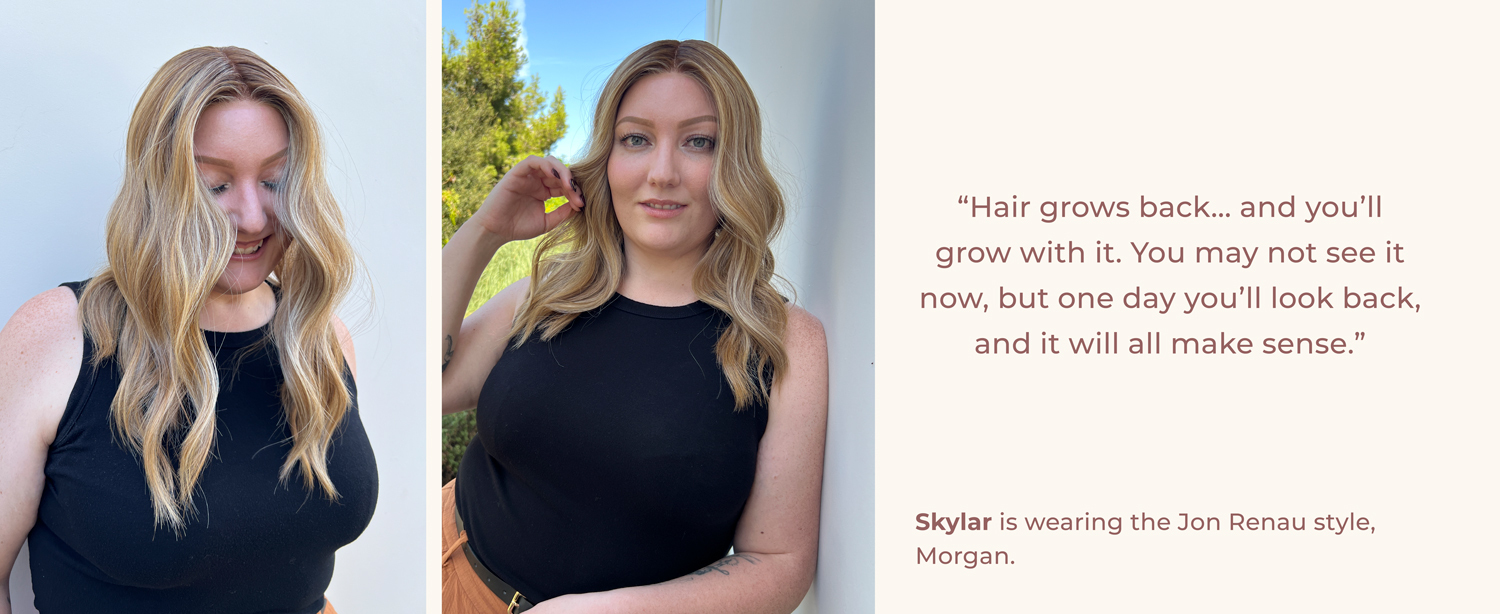
I hope you know you’re not alone; I hope you know that your identity doesn’t have to be rooted in shame. I hope you have the courage to get curious about what’s driving the hair-pulling behavior, and I hope you find people to love you well as you go through this journey. Hair grows back – and I hope you do too.
.

If you or someone you know is navigating trichotillomania, you don’t have to navigate it alone. Skylar recommends the following resources for learning more about hair pulling and finding information and support:
- TLC Foundation for Body-Focused Repetitive Behaviors: Learn more about BFRBs, treatment resources, support, and community.
- Hair Pulling: Explore information specifically focused on trichotillomania and hair pulling.
- TLC Hair Pulling Blog: Read stories and educational resources related to hair pulling and trichotillomania.
Helping people feel like themselves again is the heart of what we do. Find a style that feels like ‘you’ by visiting our Store Locator.
